Website advertising rules for banks and credit unions, checked on every change.
Every change to your site runs through 44 checks before it's saved, and the whole draft runs through them again before it can be published. Twelve are written for bank and credit union advertising. Here is every one, in plain language, with the rule it comes from and how seriously it's treated.
levels
Every finding is one of three levels.
A finding comes with what's wrong, why it matters and how to fix it, in a sentence each. No rule numbers to look up. The level decides what happens next.
Never saved. The assistant fixes it before saving and tells you exactly what it changed. This holds even when your approval rule is set to none.
Saved to the draft and flagged for a person, with the reason in one sentence. Depending on your approval rule, it waits for a reviewer.
Worth doing. Nothing is held up.
| Level | Banks | Credit unions |
|---|---|---|
| Must fix | 20 | 20 |
| Needs a closer look | 10 | 10 |
| Suggestion | 13 | 14 |
| Not checked | 1 | 0 |
The one a bank isn't checked for: "members, not customers". The five brand checks run once your brand kit has that part filled in.
example
One request, checked.
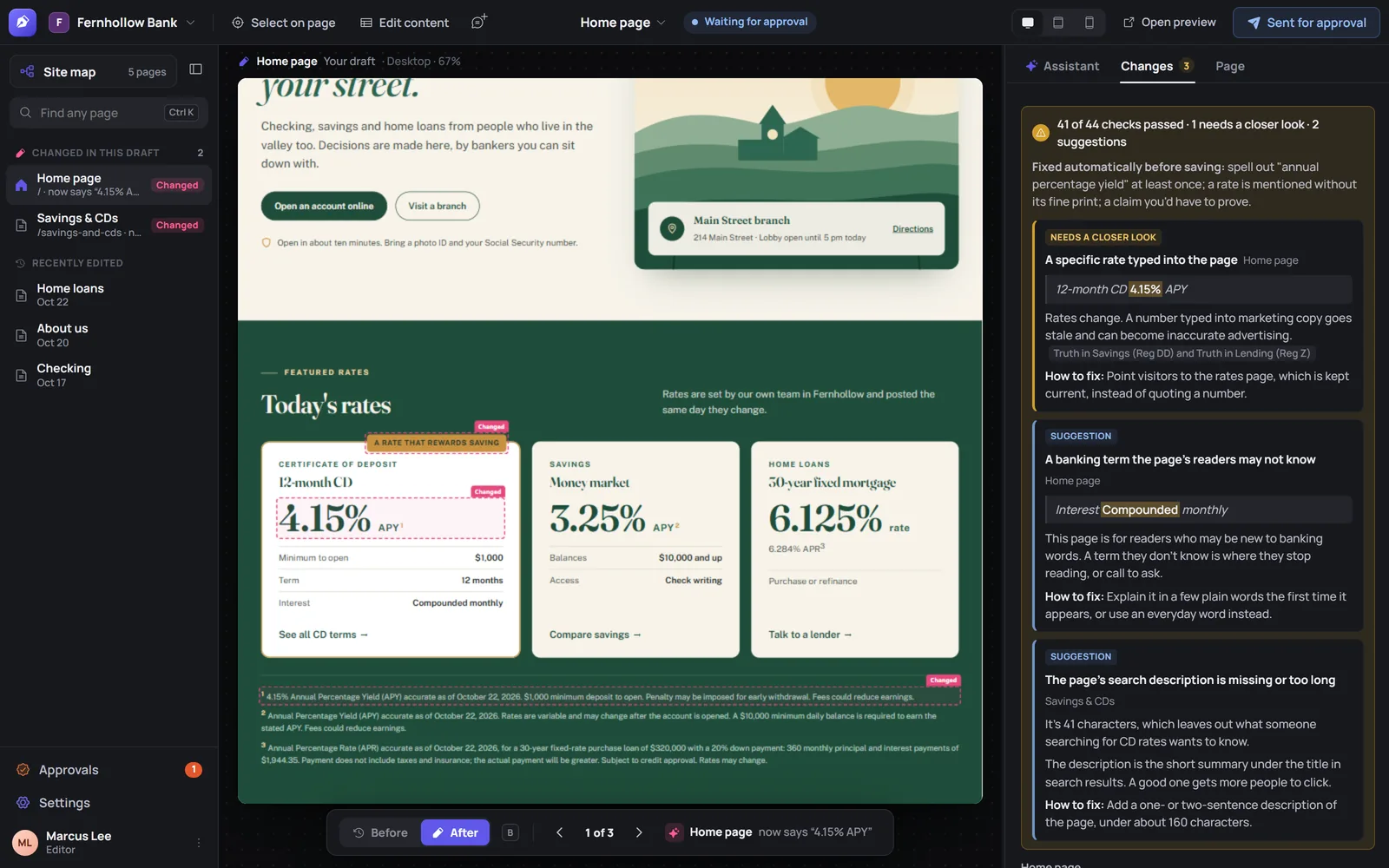
A marketing manager asks for a rate change in plain English. The assistant makes the edit he asked for, then runs the checks on it. Here is what came back, as the reviewer sees it.
Fixed before saving (3)
- No. 01"APY" without "Annual Percentage Yield". The full term now appears with the rate.
- No. 02A rate without its fine print. The disclosure was added: the date, the minimum to open, the early withdrawal penalty, and that fees could reduce earnings.
- No. 22"Best rate in town" is a claim you'd have to prove (UDAAP). It became "a rate that rewards saving".
No. 03 · A specific rate typed into the page.
Rates change, and a number typed into marketing copy goes stale. Truth in Savings (Reg DD) and Truth in Lending (Reg Z).
credit union
advertising
The twelve written for bank and credit union advertising.
These follow your charter. A credit union is checked for NCUA where a bank is checked for FDIC, and for Equal Housing Opportunity where a bank needs Equal Housing Lender. One more, No. 22 below, holds claims to UDAAP.
| No. | What it checks | Banks | Credit unions |
|---|---|---|---|
| 01 | Spell out "annual percentage yield" at least onceThe abbreviation APY may be used only if the full term also appears in the ad.Truth in Savings (Reg DD, 12 CFR 1030.8) | Must fix | Must fix |
| 02 | A rate mentioned without its fine printWhen an ad mentions an APY or APR, the conditions that go with it have to be there too, such as whether the rate can change.Truth in Savings (Reg DD) and Truth in Lending (Reg Z) | Must fix | Must fix |
| 03 | A specific rate typed into the pageRates change. A number typed into marketing copy goes stale and can become inaccurate advertising. Pointing to the rates page, which is kept current, avoids it.Truth in Savings (Reg DD) and Truth in Lending (Reg Z) | Needs a closer look | Needs a closer look |
| 04 | Spell out "annual percentage rate" at least onceLending ads must state rates as an "annual percentage rate". Spelling it out once keeps the abbreviation clear.Truth in Lending (Reg Z, 12 CFR 1026.24) | Must fix | Must fix |
| 05 | Loan details that require more disclosuresMentioning a down payment, a number of payments or a payment amount "triggers" the full terms: the down payment, the repayment terms and the APR.Truth in Lending (Reg Z, 12 CFR 1026.24) | Needs a closer look | Needs a closer look |
| 06 | Calling an account "free"An account can be advertised as free only if no maintenance or activity fee can ever be charged on it. Only your fee schedule can settle that, so a person looks.Truth in Savings (Reg DD, 12 CFR 1030.8) | Needs a closer look | Needs a closer look |
| 07 | Promising approval or a guaranteed rateApproval depends on a credit review, so promising it (or a rate) can be deceptive and can raise fair lending concerns.UDAAP (Dodd-Frank Act), fair lending | Must fix | Must fix |
| 08 | Deposit products without the insurance noticeAds for deposit products carry the official statement: "Member FDIC" for a bank, "Federally insured by NCUA" for a credit union.Banks: FDIC rules (12 CFR Part 328). Credit unions: NCUA rules (12 CFR Part 740) | Needs a closer look | Needs a closer look |
| 09 | Mentions the other deposit insurerAn NCUA mention on a bank's site, or an FDIC mention on a credit union's, can mislead visitors about how their money is protected. | Needs a closer look | Needs a closer look |
| 10 | Home lending without the Equal Housing noticeAds for mortgages and other home loans show the Equal Housing Lender logo or statement at a bank, and Equal Housing Opportunity at a credit union.Fair Housing Act. Banks: 12 CFR Part 338. Credit unions: 12 CFR 701.31 | Needs a closer look | Needs a closer look |
| 11 | A required notice was removedInsurance, fair housing and licensing notices (FDIC, NCUA, Equal Housing, NMLS) stay on the pages that carry them, even when the edit was about something else. | Must fix | Must fix |
| 12 | Credit unions have members, not customersMembers own the credit union. Calling them customers sounds like a bank. | Not checked | Suggestion |
For credit unions, Truth in Savings comes through NCUA's own version of the rule (12 CFR Part 707). The advertising checks are the same. How the checks read for a credit union
What every good page needs.
The rest are the things a careful web team checks by hand when it has time: pages people can use with a screen reader, claims you can back up, links that work, your brand, search, speed and tracking.
| No. | What it checks | Banks | Credit unions |
|---|---|---|---|
| 13 | Images need a text descriptionScreen reader users hear the description instead of seeing the image, and search engines read it too.Accessibility (ADA, WCAG 2.1) | Must fix | Must fix |
| 14 | Text is hard to read against its backgroundLow-contrast text is hard for people with low vision, and for anyone on a phone in sunlight. One of the most common accessibility complaints.Accessibility (WCAG 2.1, 1.4.3) | Must fix | Must fix |
| 15 | A form field has no labelWithout a label, people using screen readers can't tell what to type into the field.Accessibility (ADA, WCAG 2.1) | Must fix | Must fix |
| 16 | A link or button has no wordsAn icon-only link or button is announced as just "link" or "button".Accessibility (ADA, WCAG 2.1) | Must fix | Must fix |
| 17 | The page doesn't say what language it's inScreen readers and translation tools use it to pronounce and translate the page correctly.Accessibility (WCAG 2.1, 3.1.1) | Must fix | Must fix |
| 18 | Link text doesn't say where it goesScreen reader users often jump from link to link, so "click here" on its own tells them nothing.Accessibility (WCAG 2.1) | Suggestion | Suggestion |
| 19 | A page should have exactly one main headingThe main heading tells visitors and search engines what the page is about. None, or several, makes that unclear.Accessibility (WCAG 2.1) | Suggestion | Suggestion |
| 20 | Headings skip a levelScreen reader users move through a page by its headings. Skipping levels makes the outline confusing.Accessibility (WCAG 2.1) | Suggestion | Suggestion |
| 21 | An embedded map or video has no descriptionScreen readers announce embedded content by its title. Without one, visitors don't know what it is.Accessibility (WCAG 2.1) | Suggestion | Suggestion |
| No. | What it checks | Banks | Credit unions |
|---|---|---|---|
| 22 | A claim you'd have to proveSuperlatives like "best rates" or "#1 bank" can be treated as deceptive advertising unless you can document them. Describe what you actually offer instead.UDAAP (Dodd-Frank Act) | Must fix | Must fix |
| 23 | Unfinished placeholder textFiller like "lorem ipsum", "TBD" or "[insert name]" looks careless and confuses visitors if it goes live. | Needs a closer look | Needs a closer look |
| 24 | Em dash in the wordingHouse style leaves them out. They read as machine-written and break up sentences.House style | Must fix | Must fix |
| No. | What it checks | Banks | Credit unions |
|---|---|---|---|
| 25 | A page was removed without sending its visitors somewhereBookmarks, search results and links in old emails still point at the old address. Without a redirect, those visitors land on an error page. | Must fix | Must fix |
| 26 | A link or image points to something that doesn't existVisitors who click it land on an error page, or see a missing image. | Needs a closer look | Needs a closer look |
| No. | What it checks | Banks | Credit unions |
|---|---|---|---|
| 27 | A color outside your brand paletteColors picked one change at a time slowly drift the site away from the brand. Only palette colors are allowed.Runs when the brand kit has colors. | Must fix | Must fix |
| 28 | A font outside your brand fontsMixing in other fonts makes pages look like they belong to different sites.Runs when the brand kit has fonts. | Must fix | Must fix |
| 29 | The brand settings file was edited from chatThe palette and fonts are set once for the whole site. A brand change is proposed for you to apply, or made in Settings, so every page changes together.Runs when the site has a brand settings file. | Must fix | Must fix |
| 30 | A word your brand doesn't useYour brand kit lists words to avoid and what to say instead, so the site sounds the same everywhere.Runs when the brand kit has words to avoid. | Must fix | Must fix |
| 31 | One-off styling on a pageStyling added to one page instead of the site's shared styles tends to drift from the brand over time. | Suggestion | Suggestion |
| No. | What it checks | Banks | Credit unions |
|---|---|---|---|
| 32 | The page has no titleThe title shows in search results and on the browser tab. Without one, search engines guess, usually badly. | Must fix | Must fix |
| 33 | The page isn't set up for phonesWithout the mobile setting in its header, a page shows up tiny and zoomed out on phones, where most visitors are. | Must fix | Must fix |
| 34 | Search markup added to a page by handThe summary search engines and AI assistants read about each page is written from the page itself and from Settings. A hand-written one can say something the page doesn't, and stops being kept up to date. | Needs a closer look | Needs a closer look |
| 35 | The search description is missing or too longIt's the short summary under the title in search results. A good one, under about 160 characters, gets more people to click. | Suggestion | Suggestion |
| 36 | No picture for social media previewsWhen someone shares the page in a post or a text message, the preview shows this picture. Without one, it's plain or picks a random image. | Suggestion | Suggestion |
| No. | What it checks | Banks | Credit unions |
|---|---|---|---|
| 37 | Harder to read than the page's readers needEach page says who it's for, and each audience has a reading level. Long sentences and long words lose readers, and plain pages are the ones search engines and AI assistants quote most. | Suggestion | Suggestion |
| 38 | A banking term the page's readers may not knowFor readers who may be new to banking words, an unexplained term is where they stop reading, or call to ask. | Suggestion | Suggestion |
| 39 | The page doesn't give its readers the next step they needFor an audience whose next step is to call or visit, a page with no phone number loses the people who'd rather talk to someone. | Suggestion | Suggestion |
| No. | What it checks | Banks | Credit unions |
|---|---|---|---|
| 40 | A large image or fileBig files make pages slow to load, especially on phones and slower connections. | Suggestion | Suggestion |
| 41 | A page that's slow to loadImages, styles and scripts add up. Heavy pages are slow on phones, and search engines rank slow pages lower. | Suggestion | Suggestion |
| 42 | An image without its size setWithout it, text jumps around as images load, which is jarring and counts against the page in search rankings. | Suggestion | Suggestion |
| No. | What it checks | Banks | Credit unions |
|---|---|---|---|
| 43 | Tracking code from an outside companyAd pixels and session recorders (Meta, TikTok, LinkedIn, Hotjar and the like) send what visitors do on the site to another company. On financial websites they have led to lawsuits and regulator scrutiny, especially near sign-in and application pages. If you decide to use one, an administrator adds it deliberately, with the privacy notice updated to match. | Must fix | Must fix |
| 44 | Google Analytics added to a page by handAnalytics are set once in Settings and kept on every page. A copy pasted into one page counts visits twice, and stays behind where tracking should be off. | Needs a closer look | Needs a closer look |
Questions about the rules.
- What advertising rules apply to a bank's website?
- A page that promotes a deposit account or a loan is an advertisement, so the usual advertising rules apply: Truth in Savings (Regulation DD) for deposit rates and terms, Truth in Lending (Regulation Z) for credit terms, the FDIC advertising statement for deposit products, the Equal Housing Lender notice on home loan pages, and the rules against unfair, deceptive or abusive practices (UDAAP) for claims. Accessibility matters too: people using screen readers have to be able to use the site.
- Does "APY" have to be spelled out on a website?
- Yes. Under Truth in Savings, an ad can use the abbreviation APY only if the full term "annual percentage yield" also appears in it. The usual fix is to write "annual percentage yield (APY)" the first time it appears on the page. The same idea applies to APR and "annual percentage rate" for loans.
- Can we call a checking account free?
- Only if no maintenance or activity fee can ever be charged on it. If a fee can apply under any condition, say "no monthly maintenance fee" instead. The check flags the word for a reviewer, because only your fee schedule can settle it.
- Why is a rate typed into a page flagged even when it's right?
- Because it won't stay right. Rates change, and a number typed into marketing copy goes stale and can become inaccurate advertising. The change is saved, and a reviewer confirms the number before it goes live.
- Are the checks different for a credit union?
- Yes. A credit union is checked for "Federally insured by NCUA" instead of "Member FDIC", a mention of the FDIC is flagged, home loan pages need "Equal Housing Opportunity", and a page that calls members "customers" gets a suggestion. The rate rules are the same. More for credit unions
- Do the checks read Spanish pages?
- The disclosure checks know the Spanish wording, so a translated page that carries the notice in Spanish isn't held up for lacking the English one.
- Do the checks replace our compliance review?
- No. They catch the common, repeat problems before a draft reaches your reviewer, so the review is about judgment instead of spotting a missing disclosure. Your compliance team still decides what goes live. The checks are not legal advice.
Compliance still signs off. They just stop catching the same five mistakes.
See the checks run on a site like yours in a 30-minute demo. Bring whoever signs off.